Immigration, Refugees and Citizenship Canada · 2016
Redesigning the experience of waiting for citizenship
A graduate consulting engagement with IRCC to improve family-class immigration — research, strategy, and recommendations that were adopted at a departmental level.
Context
Immigration, Refugees and Citizenship Canada processes hundreds of thousands of family-class applications each year — a system that is, by design, slow, complex, and consequential. For sponsors and applicants, the experience of navigating it is defined by uncertainty: unclear timelines, opaque status updates, and a call centre that often couldn't help even when people reached it. Satisfaction was low and call volume was high, with a significant portion of calls driven not by genuine need but by a lack of reliable information.
As part of OCAD University's Strategic Foresight and Innovation program, our team was engaged by IRCC to examine the family-class immigration experience and identify opportunities to improve it — without adding significant cost. We operated as a consulting team: conducting research at IRCC offices, interviewing immigration lawyers and applicants, and working through a substantial body of materials made available to us by the department.
The Work
The research pointed to three interconnected problems. The first was transparency — applicants had no reliable way to know where they stood, and IRCC's own policies restricted what staff could share, creating a communication vacuum that drove anxious applicants to the phone. The second was call centre effectiveness — staff were often unable to answer questions meaningfully, not because the information didn't exist, but because training hadn't equipped them to handle the emotional realities of what applicants were going through. The third was systemic: a deeper cultural gap between how IRCC understood its own processes and how those processes were actually experienced by the people inside them.
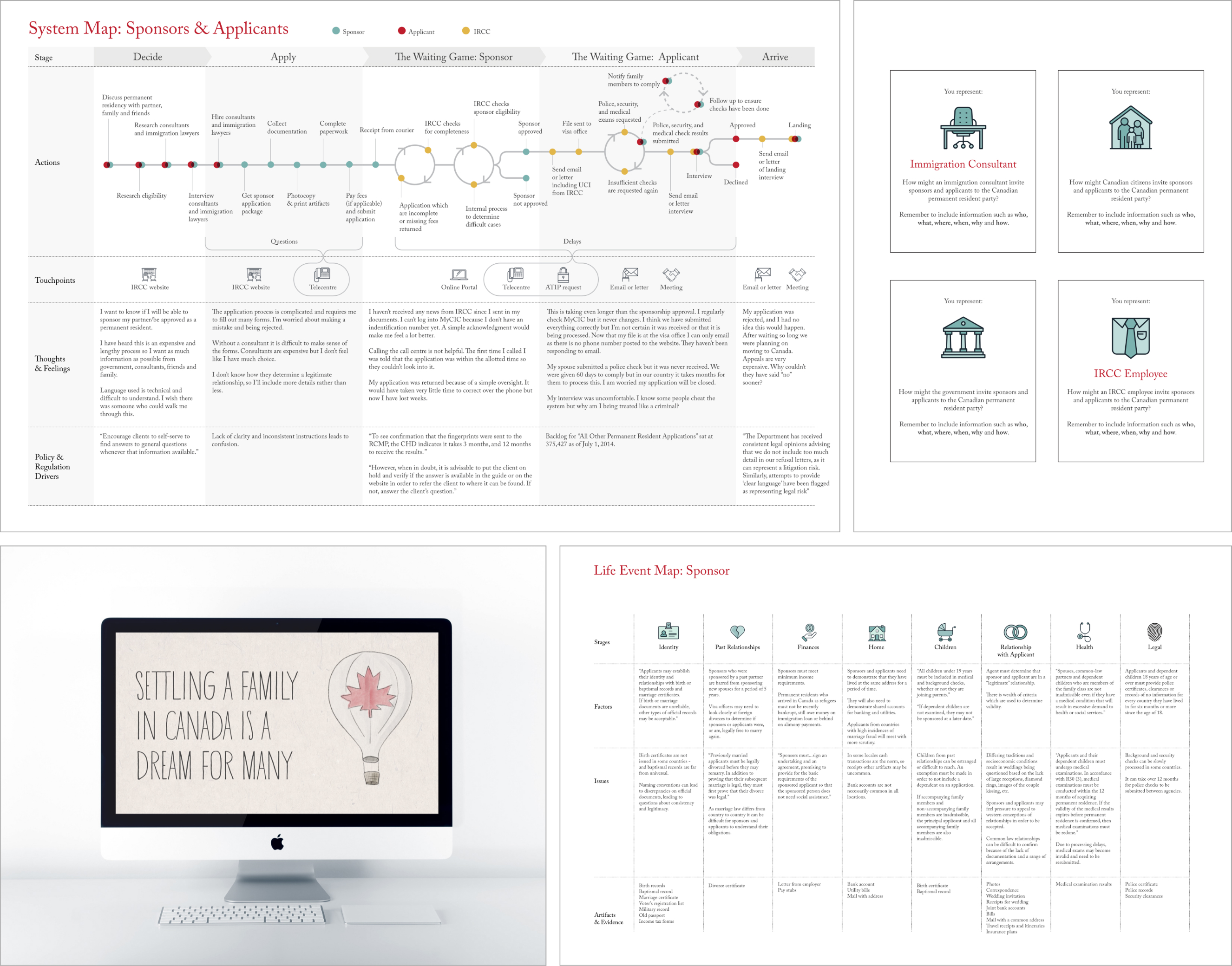
Artifacts including journey maps, workshop materials, and the video summary of our research, which was included in IRCC onboarding after the project finished.
Our recommendations addressed all three. On transparency, we proposed targeted measures to give applicants meaningful status updates within responsible limits — including a text notification service confirming receipt of key documents. On the call centre, we recommended additional training focused on both consistency and caller empathy. And at the systemic level, we made the case for a dedicated client experience function — a team whose job was to hold the applicant perspective at the centre of how IRCC designed and delivered its services.
One of the more unusual outputs of the project was a video communicating our findings — an alternative perspective on what the immigration experience could feel like. It became mandatory viewing for IRCC staff as part of their training program.
Outcomes
Many of our recommendations were adopted. In research conducted eight weeks after changes were adopted, it was found that repeat calls dropped 30%, and a client satisfaction survey showed an 85% satisfaction rate. A new client experience branch and a service insights and experimentation division — with ten staff — were established. For a graduate research engagement, the implementation rate and the scale of institutional change were significant.