Government of Newfoundland and Labrador · 2012–2016
Making climate change personal
The first public climate change awareness campaign in Newfoundland's history — interactive tools that helped people understand their own footprint and what they could do about it.
Context
The Climate Change Branch of the Department of Municipal Affairs and Environment is responsible for the development of strategy, policy, research, analysis and initiatives related to climate change adaptation and mitigation and energy efficiency.
In 2012, The Pixel Shop was selected to create the online execution of their Turn Back the Tide awareness campaign — the first public climate change awareness campaign in Newfoundland's history. The project included a website aimed at both the general public and commercial markets, along with interactive tools to help users understand their own carbon footprint and areas where they could make a difference.
The Work
After several client workshops we began working on information architecture and user experience design. The Carbon Calculator and Interactive House tools — both our own concepts — required special attention to ensure the accuracy of the information collected.
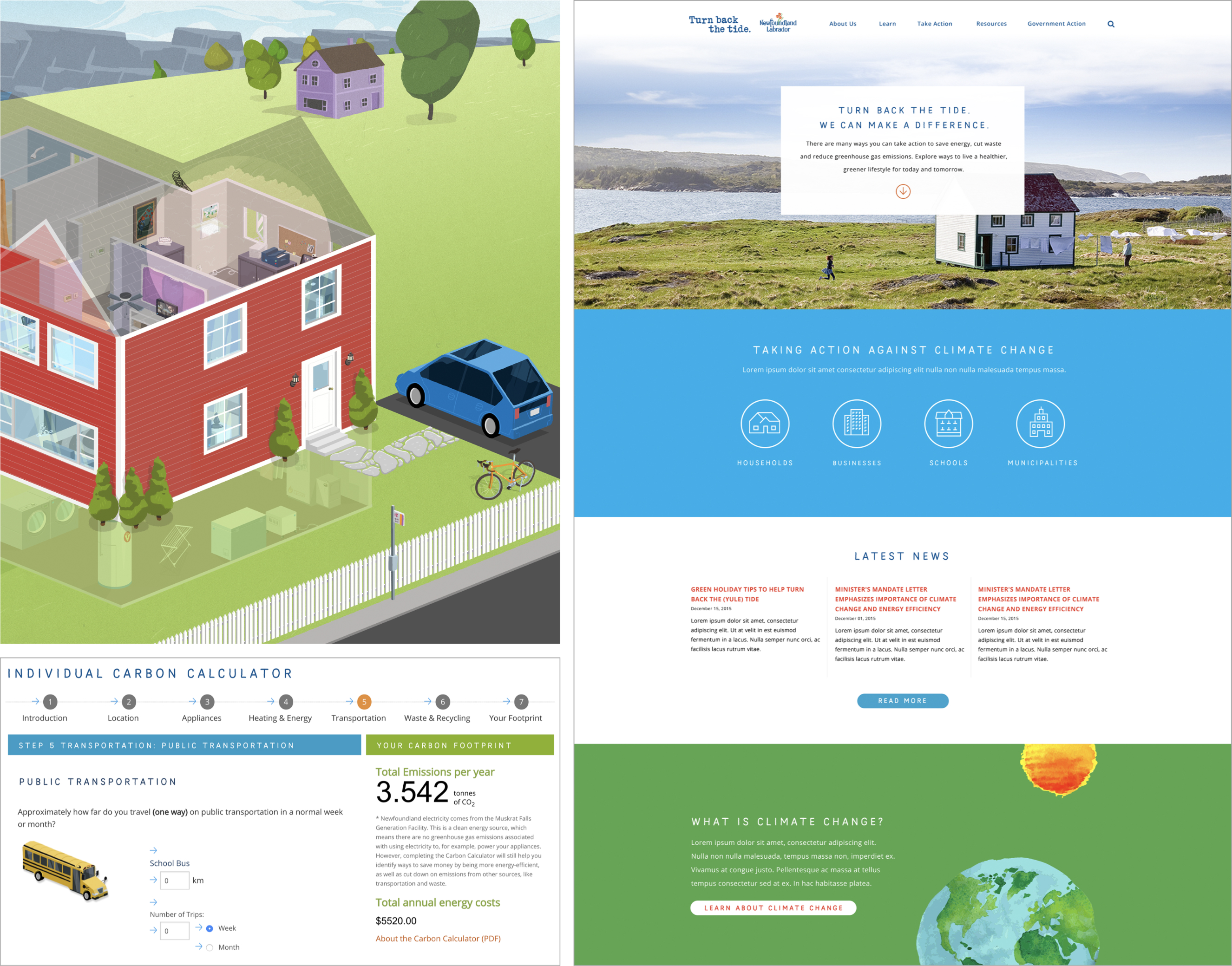
In additional to written content, tools like the interactive house and carbon calculator brought emission reduction alive to users.
To speak to Newfoundlanders it was important that the final product was consistent with their provincial character. An illustrator was commissioned to create illustrations for both tools, ensuring that houses and other objects had a distinctly east coast feel. To ensure that content such as the carbon calculator were built for reuse, allowing them to be repurposed as stand-alone web apps for a travelling school program.
The campaign was well received enough that a second engagement followed in 2016 — a new online-only campaign built on consumer research conducted after the first phase. The learnings from four years shaped a sharper, more targeted second chapter.
Outcomes
The Turn Back the Tide website reached all measurable objectives set by the client, and garnered praise from stakeholders inside the government. The online part of the campaign was so well received that a new online-only campaign and creative refresh was conducted in 2016.